.svg)
.svg)

.svg)
.svg)

Copied to Clipboard

Ready to get Started?


Key Takeaways
You can hire international employees through four main methods: setting up a local entity gives you full control, using an Employer of Record enables fast compliant hiring without infrastructure, engaging contractors provides flexibility for project work, and relocating employees lets you move existing talent to new markets.
Remote hiring comes with compliance challenges that require careful management: Each country has unique labor laws, tax obligations, and statutory benefits that must be followed to avoid legal penalties and misclassification risks (when workers are incorrectly classified as contractors instead of employees).
Leading remote teams successfully requires clear organization, strong communication, and effective project management: Time zone alignment, cultural context, and proper onboarding are essential for distributed team performance.
More teams are building across borders by default, simply because the best talent isn’t concentrated in one market anymore – and neither are your customers. When you hire globally, you can tap into both.
At the same time, hiring employees internationally introduces a layer of complexity that doesn’t exist in domestic hiring. Every country has its own rules around employment, taxes, benefits, and termination and those rules apply whether you’re hiring one employee or building a full team.
The opportunity is clear, but the execution isn’t always straightforward. So, we created this guide to help walk you through how to hire international employees step by step, and how to choose the right structure as you scale.
Quick Answer: 7 Steps to Hire International Employees
- Step 1: Decide employment type (full-time employee or contractor)
- Step 2: Choose the country based on talent, costs, and time zones
- Step 3: Select your hiring structure (entity, EOR, or contractor)
- Step 4: Handle visas and work permits if required
- Step 5: Create a locally compliant employment contract
- Step 6: Set up payroll and tax withholdings
- Step 7: Onboard employees with clear communication and tools
What Are The Ways to Hire International Employees?
Hiring employees internationally gives you flexibility in how you build your team, and that flexibility is what makes global hiring so powerful. At the same time, each approach comes with trade-offs that affect speed, cost, and compliance.
Most companies choose between three core approaches:
- Setting up a local entity for full control and long-term presence
- Using an Employer of Record for fast, compliant hiring
- Hiring independent contractors for flexibility and short-term needs
The right option depends on what you’re trying to achieve. Some companies are making a long-term investment in a specific market, while others are testing new regions or hiring just one or two employees abroad.
There’s no single “best” setup, only what makes sense for your stage, your risk tolerance, and how quickly you need to move. Let’s break down how each approach works in practice.
Option 1: Set Up a Local Entity
Setting up a local entity gives you full ownership over your operations in a country, from employment to payroll to compliance. It’s the most complete way to hire employees abroad, and it gives you long-term stability in that market.
That level of control comes with a meaningful investment of time, cost, and operational effort.
Advantages
- Full control over hiring, payroll, and employee management
- Strong protection for intellectual property and contracts
- Ability to build a long-term presence in a specific market
Costs and Challenges
- Setup timelines can range from 3 to 9 months
- Initial setup costs often exceed $20,000
- Ongoing maintenance can exceed $50,000 per year
- Requires local expertise across HR, legal, and finance
Key Takeaway
Entities work well when you’re committed to scaling in a country. They can slow you down if you’re still exploring or hiring in small numbers.
Do You Need an Entity to Hire Employees Abroad?
Hiring employees abroad gives you direct control over employment relationships and compliance, which is why entities are often seen as the default approach. In most countries, employing someone directly requires a registered legal presence to handle payroll, taxes, and statutory obligations.

That said, many companies hire globally without setting up entities by using an Employer of Record. This allows you to stay compliant while moving faster, especially in the early stages of expansion. This brings us to option 2.
Option 2: Use an Employer of Record
Using an Employer of Record allows you to hire international employees quickly while staying compliant with local laws. It’s become a go-to option for companies that want to expand globally without building infrastructure in every country.
You still manage the employee’s day-to-day work, while the EOR handles legal employment, payroll, and compliance.
What an EOR Enables
- Hiring in new countries within days
- Expanding without setting up local entities
- Staying compliant with local labor laws
What an EOR Handles
- Locally Compliant Employment Contracts: Contracts are tailored to each country’s labor laws, including mandatory clauses, benefits, and termination requirements, so you’re not relying on one-size-fits-all templates.
- Payroll, Taxes, and Statutory Benefits: The EOR manages salary payments, tax withholdings, and employer contributions, ensuring everything is calculated and filed correctly according to local requirements.
- Labor Law Compliance and Terminations: From probation periods to notice requirements and severance, the EOR ensures employment practices align with local regulations throughout the employee lifecycle.
- Multi-Currency Payments: Employees are paid in their local currency, while you manage costs in your preferred currency, helping simplify cross-border payments and reduce operational friction.
When to Use an EOR
- Hiring Your First Employees Abroad: It allows you to get started quickly without needing to build legal or operational infrastructure in a new country.
- Testing New Markets: You can explore hiring in a region, validate demand, and assess team performance before deciding whether to set up a permanent presence.
- Supporting Remote Teams: It enables you to hire the best talent regardless of location, while maintaining consistency in how employees are managed and paid.
- Transitioning Contractors to Employees: You can convert long-term contractors into full-time employees compliantly, reducing misclassification risk while retaining valuable team members.
Key Takeaway
EORs make global hiring accessible and fast. As your presence in a country grows, you can always transition to an entity structure when it makes financial sense.
Option 3: Hire Independent Contractors
Hiring contractors gives you quick access to global talent and works well for project-based or specialized roles. It’s often the fastest way to start hiring internationally, especially when flexibility matters. That flexibility works best when the relationship is clearly defined and truly independent.
Advantages
- Fast onboarding and minimal setup
- Lower overhead compared to full-time employees
- Ideal for short-term or project-based work
Risks and Considerations
- Misclassification risk if contractors are treated like employees
- Limited control over working hours and structure
- Need for strong contracts to protect IP and compliance
Key Takeaway
Contractors are useful for flexibility. They become risky when used as a long-term substitute for employees.
Hiring Method Comparison
Use this table as a guide to decide whether you require an employee or a contractor for your needs:
Ready to Hire Abroad Without Setting Up an Entity?
With Playroll’s Employer of Record solution, you can onboard international employees quickly while we handle payroll, taxes, and compliance in-country.
Book a Demo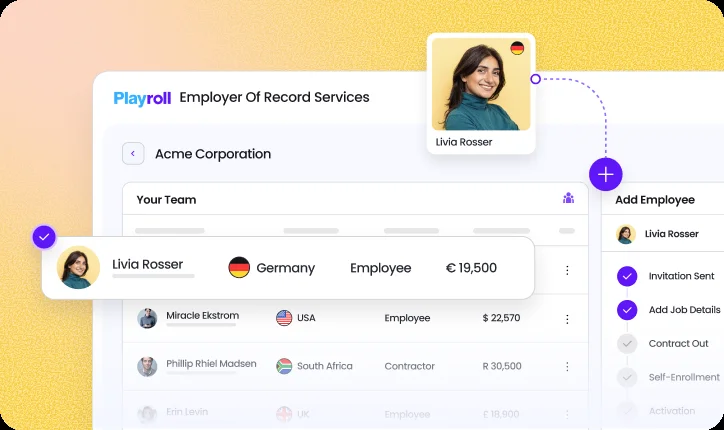
How to Hire International Employees (Step by Step)
Hiring international employees becomes much more manageable when you break it into clear steps. Most companies that scale globally follow a similar process. The difference is how well they execute each stage.
Step 1: Decide Employment Type
Start by deciding how you want to bring this new person into your team. Are they going to be a full-time employee or a contractor?
This decision shapes everything that follows. It affects:
- How you manage the person day to day.
- What you’re responsible for legally.
- How much flexibility you have as your team grows.
A good rule of thumb to follow is if the role is long-term and core to your business, it usually makes sense to treat it as full employment from the start.
Step 2: Choose the Country
Hiring globally gives you access to talent almost anywhere, but in practice, some countries are far easier to hire in than others.
Before you commit, take a step back and look at the bigger picture:
- What are the key local labor laws you need to follow and how strict are they?
- What employer taxes do you need to pay and how does this affect the total employment cost over and above your employee’s salary?
- Where is the talent you're looking for available and how competitive is the market?
- Does the time zone this talent lives in overlap with your existing team’s time zone?
Take for example if you’re looking for talent in the Netherlands. It’s a market that gives you access to highly skilled talent and a strong business environment. At the same time, it comes with stricter employment protections and higher employer costs than many other markets.
Step 3: Choose Your Hiring Structure
Once you’ve decided where to hire, the next step is figuring out how you’ll legally employ that person. This is where global hiring starts to feel more “real,” because your structure determines how everything runs behind the scenes.
As we’ve discussed, you can either set up your own entity and employ directly, hire through an EOR, or hire contractors. Some companies optimize for speed, others for long-term control. Most end up using a mix of approaches as they scale across regions.
Your choice here impacts:
- Whether you need to set up a local entity
- How payroll, taxes, and benefits are handled
- Your level of compliance risk
- How quickly you can get someone onboarded
Step 4: Handle Visas and Work Permits
If your employee will be working in a country where they don’t already have the right to work, you’ll need to handle immigration requirements.
This usually involves:
- Securing the appropriate visa or work permit
- Verifying right-to-work documentation
Even when employees are working remotely from their home country, you still need to confirm they’re legally allowed to work there. This step can take anywhere from a few weeks to several months depending on the country, so it’s worth factoring into your hiring timeline early.
Step 5: Create a Compliant Contract
One of the most common mistakes companies make is assuming their home country contracts will apply for international hires. Employment contracts need to reflect local labor laws, which can differ significantly from one country to another.
At a minimum, your contract should cover:
- Statutory benefits and entitlements
- Working hours and leave policies
- Termination requirements and notice periods
- Confidentiality and intellectual property protection
Getting this right upfront saves a lot of complexity later, especially if you need to make changes to the employment relationship later on.
Step 6: Set Up Payroll and Taxes
Paying someone in another country involves much more than just transferring their salary.
Depending on where you are in the world, you’ll need to:
- Withhold local income taxes correctly
- Pay employer contributions (which can be significant in some countries)
- Process payroll in the employee’s local currency
- Stay compliant with local reporting requirements
Step 7: Onboard Employees
Once everything is set up, onboarding is what turns a new hire into a productive team member. For international employees, this step matters even more because they’re joining remotely and often across cultures.
Focus on:
- Clear communication norms and expectations
- Time zone alignment and working hours
- Cultural context and team dynamics
- Access to tools, systems, and documentation
Done well, onboarding helps your new hire feel confident and connected from day one. And over time, that has a direct impact on retention and performance, especially in distributed teams.
Cost of Hiring International Employees
Hiring internationally gives you access to global talent and can create real cost efficiencies, especially when expanding beyond high-cost markets. At the same time, the total cost of employment includes several different elements that you might not be taking into account just yet.
Here are the key cost areas to plan for, with examples of how you’ll likely see them showing up.
1. Entity Setup Costs
If you decide to set up your own entity in Germany, the first cost you’ll face is getting established, aka registering your entity.
You might spend:
- $15,000–$25,000 on legal setup, registration, and incorporation
- Several months getting everything operational
On top of that, you’ll likely need:
- $2,000–$5,000 per month for accounting, payroll, and compliance support
That means that before your employee even starts, you’re already committing to $40,000+ in your first year.
With an EOR on the other hand, there’s no setup cost. You can hire immediately and pay a flat monthly fee instead.
2. Payroll and Tax Obligations
Once your employee is hired, salary is just one part of the equation. Let’s dive into this by looking at an example, in Germany:
- Employer contributions (social security, insurance, etc.) can add 20–25% on top of salary
Which means that a $70,000 salary becomes:
- ~$84,000–$87,500 in total employer cost
This applies whether you use an entity or an EOR, but the difference is who handles the complexity. With an entity, you’re responsible for calculating, filing, and staying compliant.
With an EOR, this is handled for you as part of the service.
3. Benefits and Statutory Requirements
German employment law includes a number of mandatory benefits and protections.
This includes:
- Paid vacation (typically 20+ days minimum, often more in practice)
- Sick leave and social protections
- Pension and health insurance contributions
These are already baked into your employer cost above, but they also affect:
- How contracts are structured
- What you’re legally required to offer
- How you manage employee expectations locally
With an entity, you need to design and manage this yourself. With an EOR, these requirements are built into the employment setup.
4. Legal and Compliance Costs
Hiring in Germany means your contracts and processes need to align with local labor law.
In practice, that often means:
- $1,000–$3,000 to draft a compliant employment contract
- Ongoing legal support if regulations change or issues arise
German labor law also includes strict rules around termination, notice periods, and employee protections.
With an entity, you’ll likely rely on external legal counsel. With an EOR, compliant contracts and processes are already in place.
5. Currency Exchange and Payments
If you’re paying your German employee from abroad, you’ll also need to manage cross-border payments.
This can include:
- Currency conversion costs (often 1–3% per transfer)
- International payment fees
- Exchange rate fluctuations over time
On a $70,000 salary, even a small percentage difference can mean thousands of dollars annually.
6. Tools and Infrastructure
Running an international employee through your own entity usually means stitching together multiple systems.
You might need:
- Payroll software
- HR systems
- Compliance tracking tools
- Local accounting support
Even for a small team, this can add between $500–$1,500 per month in tools and services.
What Tools Can Help You Hire International Employees?
Employer of Record Platforms are among the most popular solutions for hiring internationally without setting up a legal entity in each country. These platforms act as the legal employer on your behalf, handling compliance, payroll, and benefits. Global Payroll & HR Platforms help manage compensation across multiple currencies and jurisdictions. Applicant Tracking Systems (ATS) with international capabilities round out the core hiring stack.
Here are the key tool categories and examples to consider:
- Employer of Record (EOR): Playroll, Deel, Rippling, Remote; they handle legal employment, contracts, and compliance in foreign countries.
- Global Payroll: Playroll, Papaya Global, Oyster HR, Gusto Global; they manage multi-currency payroll and tax filings.
- HR & Onboarding Platforms: BambooHR, Workday, Lattice; they centralize employee data and onboarding workflows across regions.
- Immigration & Visa Management: Envoy Global, Fragomen; they assist with work permits and visa processing.
- Background Check Tools: Checkr, Sterling; these tools run compliant background checks across different countries.
- Communication & Collaboration: Slack, Notion, Zoom; essential tools for managing distributed international teams.
Legal, Tax, and Compliance When Hiring Internationally Legal Requirements for Hiring Employees in Different Countries
So now you know where, how to hire and what your options are when it comes to hiring models. Now let’s take a look at how to go about navigating a complex web of legal, tax, and compliance obligations that you’ll encounter.
Getting a handle on these basics is super important if you want to grow your global team without running into expensive issues:
Visa Types and Work Permits
One of the first hurdles in international hiring is securing the right visa or work permit for your employee to work in the United States or other countries. Common U.S. visa categories include, for example:
- H-1B Visa: For specialized workers in fields like IT, engineering, or finance, the H-1B allows U.S. employers to hire foreign workers or foreign employees for a specific period, usually up to six years.
- L-1 Visa: This visa facilitates intracompany transfers, enabling employees to move between a parent company and its foreign branch or subsidiary.
Other countries have their own visa systems with varying requirements. It’s critical to comply with these by making use of immigration services to avoid fines or legal action.
Country-Specific Labor Laws
Labor laws shape how employment works in each country, from how you hire to how you manage performance and even how you terminate employees. Understanding these differences upfront helps you avoid costly mistakes later.
At a high level, here’s how this tends to vary by region:
- Europe: Countries like France, Germany, and the Netherlands have strict rules around contracts, working hours, and termination. Dismissals often require documented justification, formal procedures, and in some cases, government involvement.
- United States: The U.S. operates largely under “at-will” employment, meaning either party can terminate the relationship with relatively few restrictions (outside of discrimination or contractual obligations).
- Latin America (LATAM): Countries like Brazil and Mexico require mandatory bonuses (like 13th-month pay), severance payments, and detailed employee protections that increase the total cost and complexity of employment.
Tax Implications and Double Taxation Agreements
When you hire employees in another country, you’re stepping into that country’s tax system and that of course comes with ongoing responsibilities.
At a minimum, you’ll need to manage:
- Income tax withholding based on local tax rates
- Employer social contributions (which can range from 10% to 40%+)
- Local reporting and filing requirements tied to payroll
On top of that, cross-border hiring introduces the concept of double taxation. Double taxation agreements (DTAs) are designed to ensure that income isn’t taxed twice across countries, but applying them correctly depends on factors like:
- Where the employee lives
- Where the company is registered
- How the employment relationship is structured
Hire International Employees Quickly With Playroll
Hiring internationally gives you access to better talent, faster expansion, and more flexibility in how you build your team. What usually slows companies down is having to deal with compliance, payroll, and legal requirements across multiple countries.
Playroll brings all of that into one place. With a unified global dashboard, built-in compliance checks, and owned local entities, you can hire in 180+ regions without setting up infrastructure. As your team grows, you keep visibility and control without the operational overhead and you’re supported by in-house experts every step of the way.
If you’re looking to simplify international hiring and grow your team without the usual complexity, book a chat with our team today.

ABOUT THE AUTHOR
Jaime Watkins
Jaime is a content specialist at Playroll, specializing in global HR trends and compliance. With a strong background in languages and writing, she turns complex employment issues into clear insights to help employers stay ahead of the curve in an ever-changing global workforce.
FAQs About Hiring International Employees
Can US companies hire remote workers from a foreign country?

.png)
Yes, US companies can legally hire remote workers from abroad. There are two main ways to do it: hire as an independent contractor (simplest option but carries misclassification risk if the worker functions like a full employee), or hire as a full employee through either establishing a local entity or partnering with an Employer of Record (EOR). An EOR hires the worker on behalf of the US company, ensuring compliance with local tax, labor, and benefits regulations.
Do US companies need a local entity to hire employees abroad?
No, US companies don't always need a local entity to hire employees abroad. For full-time employees, companies typically must either set up a legal entity in that country or partner with an Employer of Record (EOR), which handles payroll, taxes, and compliance on their behalf. Independent contractors don't require a local entity, but this approach carries misclassification risks if the contractor is effectively treated like an employee. For long-term, compliant hiring, most US companies either establish an entity or use an EOR.
How can companies stay compliant with local labor laws when hiring abroad?
Companies can stay compliant by understanding the specific employment regulations of each country, including rules around wages, benefits, working hours, leave, and termination. Many businesses partner with an Employer of Record (EOR), which handles payroll, taxes, and statutory benefits on their behalf. Clear contracts, proper classification of workers, and ongoing monitoring of regulatory changes are also essential to ensure long-term compliance and avoid legal or financial penalties.
What is the cheapest way to hire employees internationally?
The cheapest way to hire employees internationally is by using an Employer of Record (EOR). Setting up a legal entity abroad comes with steep upfront and ongoing costs, incorporation fees, tax filings, local directors, and compliance management, while paying workers as contractors may seem cheaper but carries the risk of misclassification penalties. An EOR eliminates these expenses and risks by becoming the legal employer on your behalf, managing payroll, taxes, and benefits in compliance with local laws. This means you can hire quickly and affordably without the financial burden of entity setup or the legal exposure of contractor arrangements, making an EOR the most cost-effective solution for global hiring.

Back to Top
.svg)









.svg)