.svg)
.svg)

.svg)
.svg)

Copied to Clipboard

Ready to get Started?


Hiring in the U.S. feels simple until you actually try to do it. At-will employment, no mandatory paid vacation, and one of the world's deepest talent pools, it sounds like a relatively low-friction market to enter. Then you discover that employment law operates differently across all 50 states, that California's overtime rules are essentially their own regime, and that not offering health insurance puts you at a real disadvantage when competing for talent, even when it's technically not required.
If you're a global company making your first US hires – or expanding into new states – an Employer of Record (EOR) is often the fastest, most practical way to hire and pay your team compliantly without setting up a domestic entity. This guide covers what to look for, what to expect in terms of cost, and an honest breakdown of the 11 best EOR providers for the U.S. in 2026.
What To Look For in a US EOR Provider
The US EOR market has a lot of options, and a fair amount of noise. Here's what actually separates strong providers from ones that create problems down the line:
1. Multi-state compliance depth: Federal FLSA compliance is table stakes. Ask specifically how a provider handles California's DFEH requirements, New York's WARN obligations, and state-specific paid leave mandates. If they can't give you a confident, specific answer, that tells you something.
2. Benefits infrastructure: Health insurance isn't optional in practice. Your EOR should have established group plans that new hires can access quickly. Ask which carriers they use, what the average employer contribution looks like, and how long enrollment actually takes.
3. Owned entity vs. partner network: EORs with their own U.S. legal entity offer more direct accountability. Partner networks can work fine for routine hires, but if something goes wrong during a termination or dispute, you want someone who owns the employment relationship directly.
4. Payroll accuracy across jurisdictions: The IRS and state revenue agencies penalize late or incorrect deposits. Ask prospective providers about their error rate and what happens when something goes wrong.
5. Misclassification protection: A good EOR flags risk proactively, especially in California and New York, where enforcement is aggressive. This matters a lot if you're bringing on contractors or testing whether a role needs to be a full employee.
6. Platform quality: You want onboarding, benefits enrollment, time tracking, expenses, and offboarding in one place. Check whether it integrates cleanly with your existing HRIS before committing.
7. Pricing transparency: Watch for setup fees, conversion fees (if you later want to move someone onto your own payroll), and benefit cost pass-throughs. Flat per-employee monthly pricing is easier to budget against than percentage-of-salary models that scale unpredictably as you hire senior people.
What Does It Cost To Hire a US Employee Through an EOR?
EOR platform fees in the U.S. typically run $400–$800 per employee per month, higher than most other markets because of the complexity involved: multi-state payroll registration, ACA compliance, and benefits administration all add real operational overhead.
To put that in context: three employees through an EOR might cost $1,200–$2,400 per month in platform fees alone, covering employment contracts, payroll processing, federal and state tax filings, and ongoing HR support. Health insurance premiums come on top: employer contributions for decent coverage typically add $500–$1,000 per employee per month, depending on plan tier and state. That's a real number to factor into your hiring budget before you start.
Playroll starts at $399 per employee/month, offering flat-rate billing and no hidden fees. Enterprise platforms like G-P and Pebl tend toward the higher end. Budget-focused options like Remofirst start at $199/month but typically offer less depth in U.S.-specific compliance and benefits and relies on third-party partners. You get what you pay for in a market where compliance mistakes are expensive.
The 11 Best Employer of Record Providers in the U.S. for 2026
These are the most consistently cited providers across independent 2026 rankings, including G2, People Managing People, and SelectSoftwareReviews.
1. Playroll
Price: Starting from $399/employee/month
Playroll is built on 25+ years of compliance infrastructure through the VAT IT Group, and owns the majority of its entities globally – which means fewer handoffs, fewer delays, and fewer moments where "we're waiting on our local partner" becomes your problem.
In the U.S., that translates to multi-state payroll, ACA benefits management, and state-specific contracts handled directly in-house. Every employer gets a dedicated Customer Success Manager. Every employee gets their own Employee Success Manager – someone they can actually reach, at no extra cost. That level of support is genuinely unusual in this market, where most platforms route complex queries to a ticket queue.
Onboarding typically completes within 2–5 business days, and the platform consistently earns high marks for ease of use from teams migrating off legacy systems. G2 reviewers regularly cite responsiveness as a genuine differentiator rather than just a marketing claim.
One honest trade-off: Playroll's review volume on G2 is smaller than Deel or Remote, so there's less public data on edge cases. If third-party social proof is a key part of your internal sign-off process, that's worth noting.
2. Deel
Price: Starting from $599/employee/month
Deel has the largest review base of any EOR on G2, operates through its own US entity, and handles multi-state payroll cleanly. The integration library is broad and the onboarding process is fast – it's become a default choice for tech companies that want a digital-first experience at scale.
The trade-offs are real, though. Pricing sits at the top end of the market – around $200/month more per employee than Playroll – which adds up fast if you're managing a meaningful headcount. Support quality is the more frequently cited concern: reviewers describe a ticket-driven model for anything complex, and escalation paths can be slow. If you're hiring in high-complexity states or dealing with edge cases, that response time matters.
3. Remote
Price: Starting from $599/employee/month
Remote operates through its own US entity and has a reputation for clear documentation and strong IP and equity protection. Payroll accuracy is solid and the onboarding process is well-structured, making it a reliable option for tech companies hiring senior talent where contract clarity is a priority.
Where it loses ground is flexibility. Complex US scenarios – custom benefits arrangements, multi-state employees with layered leave entitlements, and anything requiring hands-on local expertise – are consistently flagged in reviews as areas where Remote's platform is more rigid than the situation calls for. At $599/month, you're paying a premium price for a product that works well within defined parameters.
4. Rippling
Price: Not publicly disclosed (comparable to Deel)
Rippling's pitch is everything on one platform: HR, payroll, IT, and benefits. If you're already invested in Rippling's HRIS, the EOR module extends that infrastructure and reduces administrative overhead, particularly for teams combining device management with employment. That's a genuinely useful integration.
For companies that just need straightforward EOR, though, Rippling is more platform than you're likely to use. US-specific benefits customization comes with a learning curve, pricing lacks transparency, and the overall product complexity tends to create friction rather than remove it for smaller or leaner HR teams.
5. Justworks
Price: Starting from $599/employee/month
Justworks is one of the few platforms that can handle PEO, EOR, payroll, and contractor management in one place – which is a genuine advantage if you're simultaneously managing US domestic employees and international staff and want a single provider. It's well-supported and transparent on pricing.
The constraint is reach. Justworks offers direct EOR in around 17 countries. For companies with genuine multi-country expansion on the roadmap, that's a significant ceiling – and the workaround of layering in a second provider for markets outside Justworks' footprint adds complexity and cost that often offsets the convenience of the single-stack setup.
6. Multiplier
Price: Starting from $400/employee/month
Multiplier offers flat-rate pricing and a clean onboarding experience that ranks well in independent comparisons for transparency. For mid-sized companies scaling across multiple markets simultaneously, it's a practical option.
Its limitations show up in more complex scenarios: California-specific requirements, multi-state employees with overlapping leave entitlements, and custom benefits structures that require deeper in-country expertise. For straightforward hires in lower-complexity jurisdictions, it performs reliably. For anything with legal nuance, you may find the platform reaching its limits.
7. Oyster HR
Price: Starting from $699/employee/month
Oyster is built around employee experience – structured onboarding, remote-first employment design, and well-documented processes that G2 reviewers consistently highlight. For standard US hires where you want consistency across a global workforce, it works.
The trade-offs are price and flexibility. At the higher end of the market, Oyster commands a premium for a product that some users find less adaptable for complex, US-specific scenarios. If your hiring needs are uncomplicated and employee experience is the primary buying criterion, it's a reasonable fit. If you need depth on state-specific compliance or custom arrangements, it may not justify the cost.
8. Papaya Global
Price: Starting from $499/employee/month
Papaya is built for finance teams that need visibility across global payroll spend. Its analytics dashboards and multi-country reporting are among the better offerings in the market – if your CFO is closely involved in managing cost, the data infrastructure is genuinely useful.
The practical limitations are harder to overlook. US operations run through a partner network rather than a fully owned entity, which can slow down resolution of state-specific questions considerably. Variable pricing also makes cost forecasting harder than it should be, particularly for smaller teams that need budget predictability.
9. Globalization Partners (G-P)
Price: Not publicly disclosed
G-P is one of the original EOR providers and carries the compliance credentials and track record to prove it. For enterprise teams that need documented SLA commitments and a mature, auditable process, it remains a credible option.
That said, it shows its age in several ways: it's consistently among the most expensive platforms on the market, the product experience feels dated compared to newer entrants, and the sales and onboarding process is slow by design. For teams that need to move quickly or don't have a six-figure budget allocated to EOR, G-P tends to be more infrastructure than the situation requires.
10. Remofirst
Price: Starting from $199/employee/month
Remofirst has the most competitive price point on this list, and for straightforward US hires in standard roles, it's a genuinely accessible entry point into EOR.
The caveats are significant. Remofirst relies entirely on third-party providers to deliver its services, which means less direct control and a support model that depends on external partners – something that becomes noticeable when issues require escalation. California and New York compliance nuances, multi-state complexity, and custom benefits are all better served elsewhere. The low price reflects real limitations. If you're hiring simple roles in low-complexity states, it's worth considering. If your first hire is in California, do more due diligence before committing.
11. Pebl (formerly Velocity Global)
Price: Starting from $399/employee/month
Pebl – formerly Velocity Global – is the most advisory-led option on this list, with 240+ in-country experts and a services model built around cross-border mobility and complex global employment structures. For mid-to-large enterprises navigating simultaneous expansion across multiple markets, that depth is valuable.
For most hiring scenarios, it's more than you need. The service model is high-touch by design, which creates a pace mismatch for companies that need to hire quickly. Premium pricing and a more structured engagement model mean Pebl works best when complexity genuinely justifies the overhead – rather than as a default for standard EOR use cases.
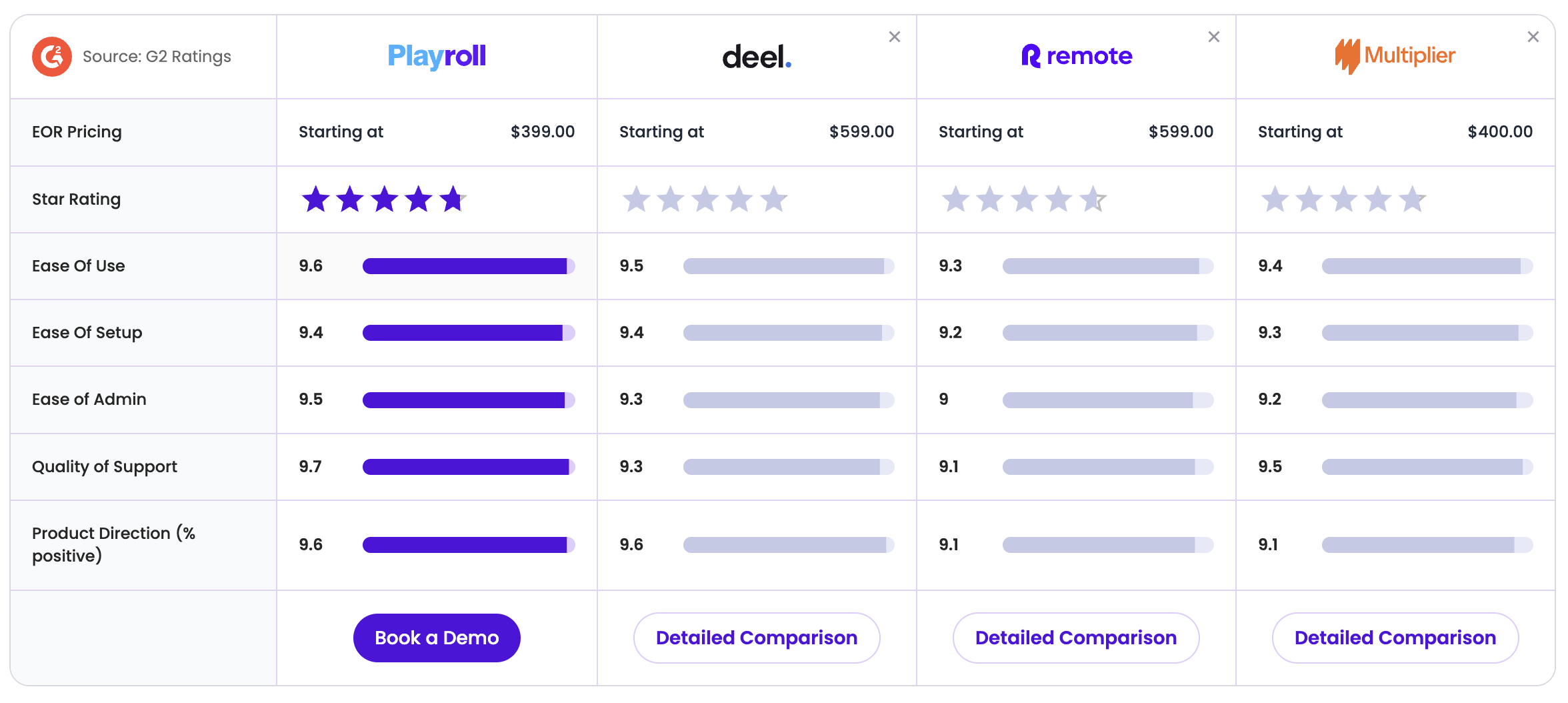
Want To See How Playroll Compares?
See how Playroll’s offering differs from other globally recognised EOR providers and find the right fit for your company.
Compare EOR providers
What Real Users Say About EOR Services in the U.S.
Across G2, Trustpilot, and Reddit, a few themes come up consistently when people talk about EOR providers in the U.S.: how well the platform handles multi-state complexity, whether benefits enrollment is actually smooth, and what support is really like when something goes wrong.
On the Playroll side, pricing transparency and the quality of human support are the most common differentiators mentioned:
"Playroll supports both the employer and the employee. The previous EOR provider we tried was a nightmare all the way around. There was no protection or support at all for our employees. We also experienced a lot of hidden fees. With Playroll, we don't have any secrets or surprises."
– Kathleen Sousa, Director of Operations, Baker’s Floor & Surface

"Playroll's onboarding process is smooth, the platform is intuitive, and the support team is always responsive and helpful. I especially appreciate the transparency around compliance and local labor laws – it gives us peace of mind when expanding into new markets."
– Verified G2 reviewer
EOR vs Setting Up a US Entity: Which Makes More Sense?
Using an EOR provider or setting up your own U.S. entity is worth thinking through before you commit either way. Both paths have real costs and genuine trade-offs.
Go with an EOR if:
• You need to start hiring in weeks, not months – entity setup in the US typically takes 4–8 weeks
• You're starting with a small team, usually under 20–25 US employees
• You want to test a market, role, or state before making a permanent structural commitment
• You have people in multiple states and want centralized payroll compliance without managing each state's tax accounts separately
• You don't want to be responsible for IRS registrations, state SUI accounts, workers' comp policies, and ACA reporting directly
Set up your own U.S. entity if:
• You're scaling past 20–30 U.S. employees, and the per-employee EOR fee starts to outweigh the infrastructure cost
• You need a permanent U.S. operational presence for regulatory, commercial, or tax structuring reasons
• You want full control over benefits plan design, equity programs, and employment policy
• Your business model requires direct employer relationships for licensing, government contracts, or regulated activities
What entity setup actually costs:
• LLC or C-Corp formation: $500–$2,000 in state filing fees, plus $1,500–$5,000 in legal fees
• Registered agent fees: $100–$300 per state per year
• Payroll infrastructure setup: $3,000–$10,000 in year one
• Ongoing accounting, tax preparation, and legal compliance: $10,000–$30,000+ per year, depending on complexity
For most global companies making their first US hires, an EOR is the right starting point. An EOR with its own U.S. entity (like Playroll) means you're dealing with someone who owns the employment relationship directly, which matters when real-world situations come up that don't follow the script.
What Does Onboarding Through a U.S. EOR Actually Look Like?
The process is more straightforward than people expect, but there's a clear split of responsibilities that's worth understanding before you start.
Your side: agree on the role, salary, start date, state of work, and any equity or benefits add-ons. You keep full control over how the person is managed day-to-day.
The EOR's side: collect the employee's documents (SSN, I-9 identity verification, W-4 tax elections, direct deposit details), draft a state-compliant employment agreement, register with the relevant state tax and unemployment insurance agencies, configure the right federal and state payroll tax withholding, and get the employee enrolled in benefits. Background checks, if needed, are arranged through the EOR's partner network.
For most standard roles, employees are ready to start within 2–5 business days. California and New York hires sometimes take a day or two longer because of additional documentation requirements.
Key Compliance Considerations for Hiring in the U.S.
Here's a practical overview of the employment rules and cultural expectations you'll encounter when hiring U.S.-based employees:
Want a Full Breakdown of U.S. Hiring Rules and Costs?
Playroll’s US Hiring Guide breaks down payroll, taxes, benefits, and everything you need to hire with confidence.
Explore U.S. hiring guide
Key Takeaways
The U.S. is a rewarding market to hire in, but it's not a simple one. Fifty state employment frameworks, federal tax obligations, ACA compliance, and a benefits landscape that directly affects your hiring competitiveness all add up to real operational complexity for a global company entering the market for the first time.
The right EOR takes that complexity off your plate. Each provider on this list has a context where it makes sense – whether that's platform scale, budget, or a specific stack integration. But if you want an EOR that owns its U.S. entity, answers state-specific questions in-house, and gives every employee a dedicated success manager from day one – not a ticket queue – Playroll is built for exactly this.
Pricing starts at $399/employee/month, no hidden fees, no annual lock-in. Book a demo and we'll show you how we'd handle your specific expansion.

ABOUT THE AUTHOR
Milani Notshe
Milani is a seasoned research and content specialist at Playroll, a leading Employer Of Record (EOR) provider. Backed by a strong background in Politics, Philosophy and Economics, she specializes in identifying emerging compliance and global HR trends to keep employers up to date on the global employment landscape.
FAQs on EOR in the United States
Is an EOR the legal employer in the U.S.?

.png)
In U.S. EOR arrangements, the EOR is generally the employer of record for payroll tax withholding and employment administration, while your company directs daily work and business priorities.
What U.S. costs are separate from EOR platform fees?
Separate costs often include gross wages, employer payroll taxes, workers' compensation premiums, and benefit contributions that vary by state and plan design.
Can an EOR hire across multiple U.S. states?
Yes, many EORs support multi-state hiring, but compliance still requires correct state tax setup, wage-hour rules, and leave policies for each employee location.
When is setting up your own U.S. entity better than using an EOR?
A dedicated entity usually makes sense when U.S. headcount is large enough that direct employment operations become cheaper than ongoing per-employee EOR fees.
What documents should a U.S. EOR maintain for compliance?
A compliant U.S. process should include Form I-9 support, payroll tax records, wage statements, and documented policy acknowledgments for federal and state requirements.

Back to Top
.svg)










.svg)