.svg)
.svg)

.svg)
.svg)

Copied to Clipboard

Ready to get Started?


Key Takeaways
Hire for leverage, not credentials, by defining the exact problem each role needs to solve and prioritizing high-ownership generalists early on.
Getting legal, payroll, and classification foundations right from the start is critical to avoiding costly compliance issues and operational setbacks.
Global hiring is a major advantage for startups, and using an Employer of Record lets you access top talent quickly without the burden of setting up local entities.
Hiring your first employees marks the transition from solo founder mode to building a real organization. Your team shapes the foundation of your culture and product, especially in the early days. That makes it one of the highest-leverage decisions you’ll make, and one of the easiest to get wrong. The difference between a strong early team and one that doesn’t stick around, often comes down to clarity on what the team must achieve, how you structure the relationship, and how rigorously you protect compliance and runway.
A misstep here can cost months of progress or force painful course corrections. This guide shows how to hire effectively for a startup in 2026, covering when you’re ready, how to hire for leverage, navigate global and classification challenges, and build scalable systems in a remote-first world.
TL;DR: Your Essential Checklist For Hiring Your First Employees
Early-stage founders typically manage these steps personally until headcount reaches 10–15. We’ll dig into the details of each next.
- Establish legal infrustructure before opening any role.
- Define the exact problem this hire must solve.
- Source talent and evaluate with precision.
- Classify correctly: employee or contractor.
- Draft compliant contracts and offer terms.
- Implement payroll, benefits, and equity.
- Execute international hiring compliantly and efficiently.
How to Hire Your First Employee
If you’re wondering how to hire your first employee, the key is focusing on impact over experience. Startup workers who thrive in ambiguity and take ownership deliver the biggest early wins.
Step 0: Legal Readiness, The Non-Negotiable Foundation
Before hiring your first employee, make sure your company has the legal and payroll infrastructure required to employ someone compliantly. Setting these foundations early prevents payroll delays, tax issues, and administrative surprises once your first hire starts.
- Register As An Employer: Obtain an Employer Identification Number (EIN) if your company is incorporated in the U.S., and register as an employer in the state where your employee works. This typically includes state employer tax registration and state unemployment insurance.
- Set Up Payroll And Tax Withholding: Implement a payroll system or provider that can handle salary payments, tax withholdings, and employer tax filings. Payroll must account for federal, state, and local tax obligations.
- Prepare Mandatory Employment Forms: Ensure new hires complete required documentation such as Form W-4 for tax withholding and Form I-9 for employment eligibility verification. Additional state tax forms may also apply depending on the employee’s location.
- Issue A Written Employment Agreement: Provide a clear contract outlining the employee’s role, compensation, working arrangement, and termination terms. Include confidentiality and intellectual property clauses to protect company assets.
- Create Basic Workplace Policies: Develop a lightweight employee handbook covering expectations like remote work norms, working hours, time-off policies, and conduct standards. Even simple documentation helps establish consistency as the team grows.
Step 1: Hire for Leverage, Not for Activity
The most frequent early mistake that we see new founders make, is hiring someone impressive instead of someone who removes a specific constraint. This is especially true in an early stage startup, where every hire directly impacts speed and survival.
Ask yourself: What is the one thing preventing faster progress right now? Frame the role around that outcome.
In-House Recruiter vs Agency For Startup Hiring
Choosing between an in-house recruiter and an external agency comes down to speed, cost, and the level of control you need. In-house recruiters are a better fit once hiring becomes consistent and you want someone embedded in your culture, employer brand, and long-term talent strategy.
Agencies, on the other hand, are ideal in the early stages when you need to move fast, tap into specialized talent pools, or don’t yet have the volume to justify a full-time hire.
For most startups, agencies can help you get initial traction by filling critical roles quickly, while an in-house recruiter becomes valuable once hiring turns into a repeatable function rather than a one-off need.
Practical Questions To Guide Your Decision:
- Which bottleneck is most expensive in terms of time, revenue, or user experience?
- Does this require deep specialization, or can a high-agency generalist deliver 80% of the value?
- What measurable progress should this person achieve in the first 90 days?
In the earliest stages, generalists with strong ownership tend to create more momentum because they adapt to rapidly evolving priorities.
Examples That Have Proven Effective:
Target impact in one of three areas: product velocity, customer/revenue growth, or operational stability.
Here are some examples of what that might look like in practice:
- A SaaS company hires a product engineer who owns features from ideation through deployment and customer feedback.
- A marketplace hires a growth lead who designs, executes, and iterates on acquisition experiments independently.
Step 2: Source and Evaluate with Discipline
How startups recruit differs from big companies. We suggest prioritizing ownership, adaptability, and cultural fit over perfect credentials. Early hiring decisions shape your company culture and execution speed.
The goal isn’t just finding great people, but identifying top candidates who can operate with high ownership. Start with a concise job description focused on outcomes and autonomy. Being transparent about the reality of what it’s like working in a startup, will help you to attract the type of candidates that will do well in that environment.
Example of an outcome-focused job description opener:
Own end-to-end delivery of key product features in our fast-moving early stage startup. You’ll ship weekly, make independent trade-offs, and help define our day to day processes while driving measurable user impact.
Here are a few sourcing channels that consistently produce the highest-quality early hires:
- Personal and investor networks (often the highest signal-to-noise ratio)
- Startup-focused job platforms such as Wellfound
- Targeted LinkedIn outreach to operators already working in startups
- Founder communities, operator groups, and niche technical forums
- You can also use startup-focused job boards to reach more relevant potential candidates.
- Founder communities, niche technical forums, GitHub, Discord, and X/Reddit.
- AI-powered sourcing tools for broader reach and smarter matching.
How to Modernize Hiring in 2026 with AI and Streamlined Interviews
If you’re looking to optimize your process, there are a couple of different tools that you can lean on. You can for example, use AI recruiting tools for resume screening, skills-based matching, and initial candidate outreach. This speeds up finding great people while reducing bias and manual work. Keep the interview process to 3–4 focused rounds: skills assessment, values/cultural fit, and a short paid work sample or trial project. This is far more predictive than long interview loops.
Key Tip: Don’t forget to conduct reference checks and ask questions about past startup experience to spot high-ownership candidates!
Attract the Right Candidates With Smarter Job Descriptions
Create clear, compelling job postings in minutes with our customizable templates. Save time and attract the right candidates with job descriptions designed for modern hiring.
Explore Library
Step 3: Employee vs Contractor: A Decision with Long-Term Consequences
Many early-stage startups rely on contractors to stay flexible, but the distinction between contractors and employees carries legal and operational implications.
What Is the Difference Between an Employee and a Contractor?
Contractors are most appropriate when the work is clearly scoped, independent, and temporary. Examples include redesigning a marketing website, implementing a specific infrastructure upgrade, or providing short-term advisory expertise.
Employees, on the other hand, are typically the right choice when the role:
- Contributes to core product development or revenue generation.
- Requires ongoing collaboration with the team.
- Involves direct supervision or structured working hours.
- Is expected to continue indefinitely.
Misclassification rules have become significantly stricter in recent years. Authorities in the U.S., EU, and many APAC jurisdictions actively audit companies that treat long-term team members as contractors.
If a person is integrated into your workflow, uses company tools, attends regular meetings, and reports to a manager, regulators generally view that relationship as employment. When uncertainty exists, treating the role as an employee position is usually the safest and most sustainable approach.
Step 4: Contracts That Protect Both Sides
Employment contracts are often treated as formalities, but they define the expectations and legal protections that govern the relationship.
A well-structured contract should clearly address:
- Compensation: Base salary, bonuses, and equity where applicable
- Intellectual property: Explicit assignment of work created during employment
- Employment terms: Probation periods, notice requirements, and termination conditions
For startups, intellectual property clauses are particularly important. Without clear assignment language, ownership of code, designs, or inventions produced by employees may remain legally ambiguous.
For international hires, contracts should also reflect local labor regulations. Many countries require specific statutory language around working hours, leave entitlements, and termination protections, which means U.S.-style agreements often need adaptation.

Step 5: Payroll, Benefits, and Equity Setup
Before an employee’s first day, payroll infrastructure should already be operational. Payroll includes everything from tax withholding, to statutory contributions, regulatory reporting, and compliant payslip generation.
Startups commonly use specialized payroll platforms to automate these processes.
For U.S.-based teams, tools like Playroll provide streamlined payroll, benefits administration, and HR workflows. As hiring expands internationally, companies often adopt global payroll or Employer of Record solutions that manage compliance across multiple jurisdictions.
Several platforms now serve this function for distributed teams, including Playroll, Deel, RemoFirst, OysterHR, and Remote. These systems centralize payroll processing, employment documentation, and benefits management for international hires.
Equity For Early Hires (2026 Benchmarks From Carta And SaaStr Data):
- Standard Structure: 4-year vesting with 1-year cliff.
- True First Employee: Median ~1.5% (often 0.5–4% range depending on role/impact; technical founding engineers frequently at the higher end). Grants drop quickly – ~0.85% for #2, ~0.5% for #3, and under 0.4% by #5.
- Maintain a 10–20% option pool. Complete a 409A valuation for U.S. companies.
Key Stat: Benefits typically add 20–30%+ to total compensation costs.
Step 6: Access Global Talent Without the Overhead
With remote work the default in 2026, hiring for your startup should consider international talent from day one.
The challenge is that employing someone in another country typically requires a local legal entity. This can involve months of setup, high costs, regulatory filings, and ongoing administrative overhead. For just a few hires in one country, this investment often doesn’t make sense.
An increasingly common alternative is using an Employer of Record. In this model, the EOR becomes the legal employer in the worker’s country, handling payroll, benefits, tax filings, and compliance while the startup manages the employee’s day-to-day work.
For example, a U.S.-based startup might hire:
All without establishing separate entities in each country. Leading EOR providers used by startups in 2026 include Playroll, Deel, RemoFirst, OysterHR, and Remote. These platforms allow companies to onboard international employees within days while maintaining compliance with local labor regulations.
As teams grow, companies sometimes transition to establishing their own entities in countries where they have significant headcount. Until that point, EOR models provide a practical way to access global talent without heavy operational infrastructure.
Hiring Globally? Skip the Entity Setup
You don’t need to open entities in every country to build a great team. See how startups hire and pay international employees compliantly without the overhead.
Book a Demo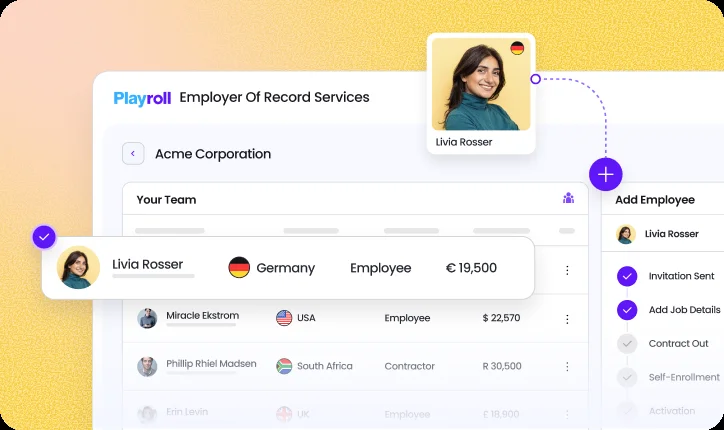
Common Mistakes Startups Make When Hiring
Hiring mistakes in early-stage startups are rarely random. They tend to follow predictable patterns that create downstream risk if not addressed early.
The most common issues we see, usually centre around how the hiring process is structured and executed:
- Hiring Too Fast: Rushed hiring often leads to unclear expectations and poor role alignment. If you skip proper evaluation or hire reactively, it increases the likelihood of early turnover and lost time. A more effective approach is to define the problem the role solves before starting the hiring process.
- Ignoring Compliance Requirements: Employment laws, tax obligations, and payroll requirements are often overlooked in early hiring decisions. This can result in unexpected tax liabilities, penalties, or regulatory audits. Even a single misstep, like incorrect classification or missing payroll registration, can create long-term issues.
- Overusing Contractors for Core Roles: Contractors are useful for short-term or project-based work, but relying on them for core functions limits ownership and continuity. It can also create misclassification risk if contractors are treated like full-time employees.
- Poor Documentation and Unclear Agreements: Missing or vague employment contracts, unclear equity structures, and inconsistent offer terms can lead to disputes later. Strong documentation protects both the company and the employee from misunderstandings.
- Not Planning for Global Expansion Early: Many startups begin hiring internationally without considering the legal and operational requirements involved. Without the right structure, this can lead to payroll delays, compliance gaps, or permanent establishment risk in foreign markets.
Key Takeaways
Your early hires shape everything, from how fast you ship to how your company culture forms. That makes hiring with a clear vision in mind really important. Define the problem, evaluate properly, and set up the right legal and payroll foundations from day one. Small mistakes here tend to compound, while getting it right creates real momentum.
As you start hiring globally, complexity can slow you down fast. Partnering with an EOR like Playroll lets you skip entity setup, reduce costs, and hire international talent in days instead of months, all while staying compliant. You stay in control of your team, just without the operational drag.
Book a demo with our team and let’s talk about how we can help you start building your global team!

ABOUT THE AUTHOR
Jaime Watkins
Jaime is a content specialist at Playroll, specializing in global HR trends and compliance. With a strong background in languages and writing, she turns complex employment issues into clear insights to help employers stay ahead of the curve in an ever-changing global workforce.
How to Hire Employees For a Startup FAQs
Do startups need to set up payroll before hiring?

.png)
Yes, startups need to set up payroll before hiring in virtually every jurisdiction. Payroll infrastructure is required to legally pay employees, handle tax withholding, and meet reporting obligations from day one. Even if you are hiring your first employee, payroll must be in place to stay compliant.
When should a startup make its first full-time hire?
A startup should make its first full-time hire when operational tasks consistently prevent founders from focusing on product development or revenue generation. The right hire restores leverage by taking ownership of critical work that directly impacts growth.
Should startups hire employees or freelancers?
Startups should hire freelancers for short-term, project-specific work and employees for long-term, core roles. Employees are better suited for positions that require deep integration into the company and ongoing accountability. Misclassifying employees as freelancers can create significant financial and legal risk.
How long does it take to hire an employee at a startup?
It typically takes startups 2 to 6 weeks to hire an employee for early-stage roles. However, hiring internationally can extend timelines to 6 to 8 weeks or longer, especially if setting up an entity or working through an Employer of Record.
How do startups offer equity to employees?
Startups offer equity to employees most commonly through stock options with a 4-year vesting schedule and a 1-year cliff. Early key hires often receive between 0.5% and 1.5% equity, with technical roles typically around 1%. Most startups also create a 10% to 20% option pool early and structure equity according to local tax and valuation rules.

Back to Top
.svg)






.svg)